I’ve had an X-Tronic 5040 XTS soldering station since 2018, possibly longer. It’s been a great unit! I’ve periodically had to replace the iron handle, and recently had to replace the heat gun, as well as the heat gun stand. Each of those parts are $15~$30, so considering the whole station cost $300 new and all the use I’ve gotten out of the thing, I’m not gonna complain about that!
Here in 2026 though, I had a very peculiar type of failure. I was trying to solder wires to the heated bed of my Creality Ender 3 Neo 3D printer, which is an incredibly difficult task, as it sinks in LOTS OF HEAT. One moment, it’s melting the solder of the wire, and then the next moment, it seems like the iron went cold. Okay, I guess the print bed just sucked the heat out, right?
Well, I took the iron away from it, and I tried to melt solder. It didn’t melt! What in the world!?
The temperature display for the soldering iron was dropping in temperature, despite the fact it was still set to 480 C. How utterly strange! I’ve never seen this happen on the unit before. I figured that perhaps the iron’s heater died, which although I’ve had to replace the iron handles, it’s never been because of the heater – rather, the casing of it.

I opened up the iron and I gave a check to the wires coming from the heating element. One pair is for the heating element itself, the other for the temperature sensor. I ensured that their resistance readings seemed about what they ought to be.
Yet, the iron obviously wasn’t working. So, I figured the issue might’ve been the cable, but as far as my continuity testing showed, that seemed to be fine. I’ve not done anything to harm the cable, so while I know it’s not impossible, it seemed unlikely, especially given the sequence of events.
After just having made do using a likely 40-year-old RadioShack 30W iron, I let the X-Tronic sit for awhile, tending to life and other things, until I felt like analyzing it. Once it was time for me to check it out, I went ahead and opened up the base unit. It was rather funny, considering that just a few weeks prior, I had opened it up to give it its first good cleaning out – a well-deserved servicing.
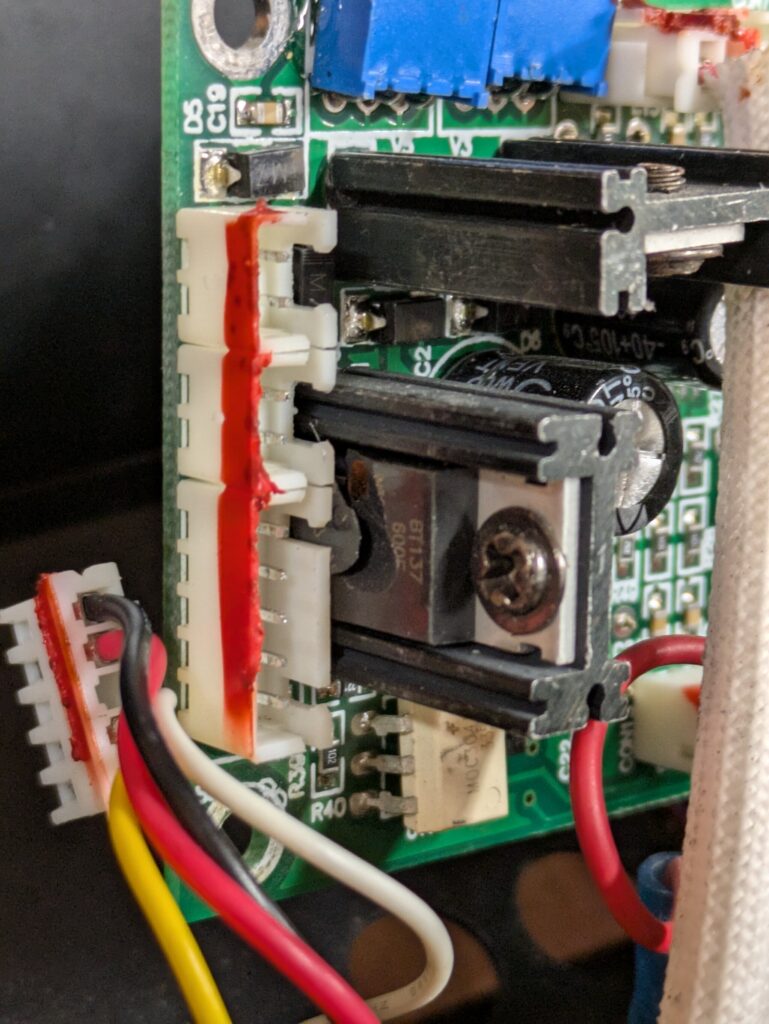
Holy macaroni! What the hell is this? Well, if that’s not a quick diagnosis! There’s no way this little three-legged guy is supposed to be blown in half! With little surprise, I verified this connects to the header where the soldering iron power comes from, confirming this is indeed part of the failure. It’s an NXP BT137-600E TRIAC. And what’s that do? To put it simply, it controls the soldering iron’s heater. So, the heater control went kablooey. No wonder!
There’s no mystery here as to how the iron isn’t working, but what eludes me is how did this fail so suddenly? I didn’t hear anything go ‘pop’ or the like. I also hope that the rest of the unit is okay. From what I can tell, absolutely nothing else looks amiss – no other exploded components, no burn marks, nothing. So, hopefully this TRIAC simply had decided that now was the time to go.
It does make sense though, as the heat gun & board preheater still work no problem, and this component is only on the circuit for the iron. So, everything seems to be pointing in an optimistic direction. And heaven knows it was cheap enough; for less than the price of a coffee today, I ordered a couple of brand-new, exact-replacement BT137-600E TRIACs from eBay, with the hopes that nothing else was wrong with my unit. They soon came in, and it was time to install one!
It was very easy to do using my TS101 iron that I (thankfully) keep as an alternative to my main station. I usually use for more portable needs, but it’s sure great to have it for my unexpected case of a dead iron on my trusty main unit! Like I did for my recent PCchips M748LMRT motherboard – I didn’t settle for simply throwing in a new component, but instead I gave it a little extra help by putting some thermal paste on the replacement component. Why X-Tronic didn’t do that to start with eludes me, I guess they figured screw tension was good enough, and considering it worked for 8 years, I guess I can only complain so much.
Now, don’t do what I did, and start pulling cables before you realize what needs to go where. This actually is what happened right after I opened it to do this repair, but thankfully I managed to figure it all out by looking at the transformer’s label for what each wire puts out. The fact one such was 26 VAC, another 10 VAC, and the iron is 24 V, was pretty much a dead giveaway which one went to that TRIAC.
Having figured that out, I put it all together, flicked the switch on, braced for impact, and plugged it in. IT WORKS!! Hell yeah! Actually a pretty easy fix, after all! The worst thing is always the uncertainty, that even if you manage to find a culprit, there might be much more to the picture. And thankfully, considering it’s been a few weeks now and it’s still working just as good as it always did, I think it’s safe to say it’s a success! 🙂